Clothbound Britain: The Quiet Cult of the Useful Souvenir
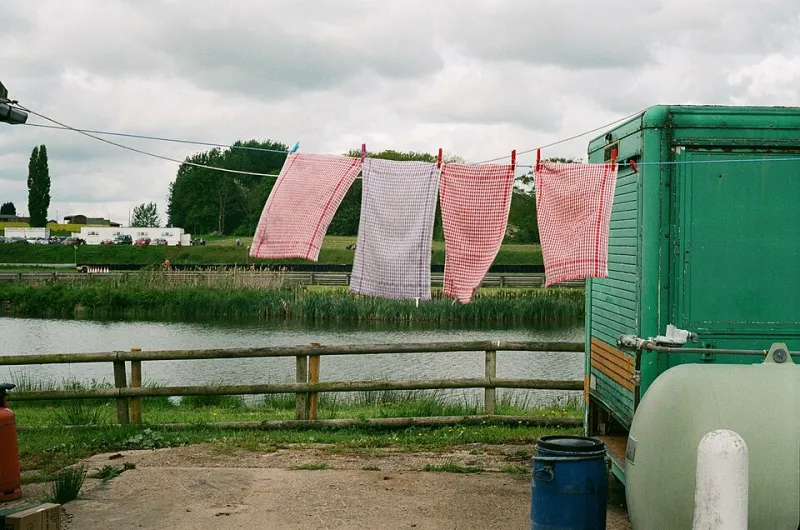
Photo: John Winder , CC BY-SA 2.0, via Wikimedia Commons
There is a particular kind of British souvenir that does not ask to be displayed. It lives in a drawer, gets folded into quarters, and spends most of its life slightly damp. The tea towel is the least precious object in the kitchen and, increasingly, one of the most collected. Not because it is rare — you can buy one for a tenner in almost any coastal town — but because it has quietly become a way of mapping the country, one square of cotton at a time.
The ten-pound artwork
Walk into a independent gift shop in Whitby, Rye or St Ives and you will find them: tea towels pinned to the wall like small, useful paintings. A stylised lighthouse. A row of beach huts. A cat asleep on a fishing boat. The best ones are not photographs printed on demand; they are drawn, coloured and often signed by the person who made them. At a moment when a decent art print can cost more than a meal out, the tea towel offers something strange and appealing: an original illustration you are allowed to ruin.
That permission matters. Collectors talk about the tea towel as a democratic object. It is cheap enough to buy on impulse, sturdy enough to survive the wash, and useful enough that nobody questions why it is in the house. “It’s the only souvenir I don’t feel guilty about,” one collector in Bristol tells me. She has around forty, stored in a linen press, rotated according to season. Her rule is simple: if she would not hang it on a wall, she does not buy it. The drying-up is a bonus.
An archive you can dry dishes with
The collector’s moment is not really about nostalgia for drying dishes. It is about place. A tea towel is a small, portable claim on somewhere you have been. The faded ones — the 1970s seaside classics with their slightly wonky typography and sun-bleached palette — are now sought after precisely because they capture a version of Britain that no longer exists. A towel from a long-closed pier or a demolished lido is a fragment of local history that happens to be hemmed on four sides.
Museum shops have understood this better than most. The commission is now a small art form: illustrators are asked to compress an entire collection or landscape into a rectangle that will be folded, washed and eventually worn thin. The V&A, the Tate and a dozen smaller regional museums have turned the tea towel into a kind of affordable edition. You are not buying a souvenir of a visit; you are buying a piece of the place, reproduced with enough care that it survives the kitchen.
The new illustrators
What has changed in the past few years is who is making them. A younger generation of illustrators, many of them working from kitchen tables in smaller towns, has taken the format seriously. They use risograph textures, hand-lettering and colour palettes that owe more to mid-century travel posters than to the souvenir rack. Some sell directly through Instagram; others supply the growing number of independent shops that treat local goods as a form of curation.
In Margate, a designer who produces tea towels of the town’s brutalist car park and its faded amusement arcades says the appeal is partly practical. “People want something from a place that isn’t a joke,” she says. “A tea towel can be affectionate without being ironic. It can say: I noticed this. I live here, or I visited, and I paid attention.” That attention is the thread running through the best of them. The tea towel is not a grand statement. It is a small, domestic act of looking.
How to collect without becoming a hoarder
The collectors I speak to are refreshingly unsentimental about condition. A washed towel with a faint stain is not ruined; it is used. But there are rules. Buy what you would actually hang. Avoid the mass-produced caricatures — the ones with cartoon corgis and union flags — unless that is genuinely your thing. Look for signed designs, small print runs, museum commissions and anything that feels specific to a street, a bay or a building rather than to “Britain” in general.
The result is a collection that behaves less like a cupboard of clutter and more like a stack of postcards from places that have mattered. It is an accidental archive of how the country sees itself: fond, dry, occasionally wistful, and always ready for the next wash. In a world of expensive, fragile souvenirs, there is something quietly radical about a keepsake you can use. The tea towel asks for nothing but a hook and a bit of attention. That, perhaps, is why it has become a pearl among the tea things.