Cypher Marks the Spot: The Quiet Cartography of Britain’s Rarest Letterboxes
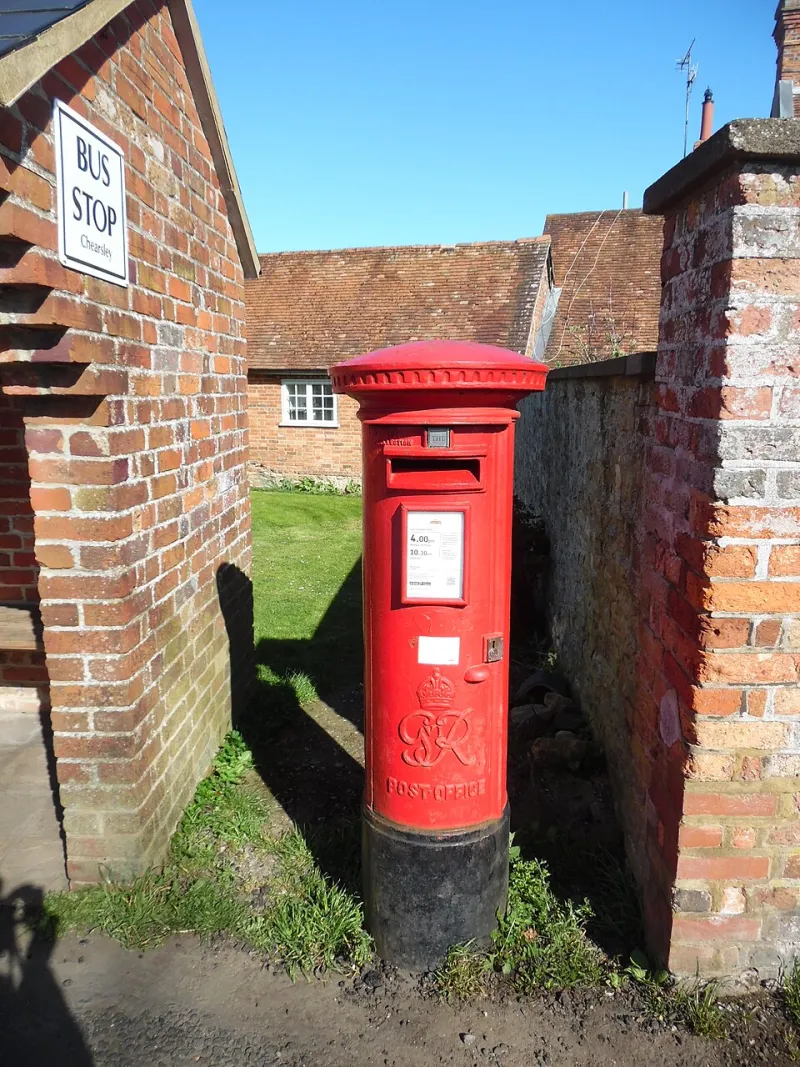
Photo: David Hillas , CC BY-SA 2.0, via Wikimedia Commons
There is a particular kind of British treasure hunt that requires no metal detector, no muddy boots and no permission from the landowner. It begins with a red shape at the edge of vision — a pillar box standing outside a village hall, a wall box set into a brick wall, a lamp box perched like a lantern on a seaside promenade. Most people see a place to post a birthday card. A smaller, quietly devoted group sees a dateable object, a piece of street furniture with a family tree, and a clue to how a neighbourhood has changed.
The cast-iron census
The Letter Box Study Group, founded in 1976, is the best-known keeper of this particular flame. Its members record post boxes across the UK, noting make, model, manufacturer, royal cypher, location and condition. What sounds like trainspotting with stamps attached is really a form of local history from the pavement. A box can tell you when a suburb was built up, where a railway station once stood, or which lane was important enough to merit a collection plate before the bypass arrived.
The appeal is partly taxonomic. There are pillar boxes, wall boxes, lamp boxes and the odd hybrid that seems to have been designed by committee. There are early green boxes, before red became the familiar signal of the postal service. There are boxes with narrow apertures, double apertures, unusual doors and manufacturer’s plates worn smooth by a century of weather. To the uninitiated, they are all red. To the initiated, they are a field guide.
In 2026, the hunting is more collaborative than ever. Photographs are uploaded with grid references, access notes and the sort of local intelligence that only comes from standing in the rain: which side of the road gets the morning light, whether the box is best approached from the churchyard, and where you can park without annoying the pub. The result is a living map that is part archive, part excuse for a Sunday drive.
Cyphers and clues
The royal cypher is the headline act. Victoria’s VR, Edward VII’s intertwined letters, George V, Edward VIII, George VI, Elizabeth II and, more recently, Charles III — each offers a rough dating kit and a small lesson in monarchical branding. Some cyphers are common. Others are rare enough to make a collector’s pulse do something undignified. Edward VIII boxes are especially prized because his reign was short; a box bearing those letters is a compact monument to an interrupted history.
Then there are the anomalies. In Scotland, some boxes are deliberately anonymous, carrying no royal cypher at all. The absence is not a mistake but a piece of constitutional sensitivity, and it gives Scottish streets a parallel letterbox language. Elsewhere, a box may survive with an unusual maker’s mark, a replacement door, or a coat of paint that has been applied so many times the lettering looks soft and sugared.
This is where the hobby becomes something closer to reading. A cypher tells you the official era; the wear tells you the local era. A box outside a post office that has become a bakery, a dental surgery or a holiday let is a small essay on rural change. A box on a housing estate built in the 1960s but bearing a much older design may have been moved, reused or saved from another site. The cast iron does not just record the postal service. It records us.
The quiet vanishing
There is an elegiac note to the pursuit, too. Post boxes are not disappearing in a dramatic, front-page way. They are being removed, replaced or left to rust in the margins of road schemes, redevelopments and changing delivery patterns. A box that has stood at a crossroads for a hundred years can vanish in a week, leaving a pale rectangle on the wall and a gap in the local furniture.
That is why the photographing matters. The documentarians are not just ticking off rarities; they are making a record of ordinary infrastructure before it is quietly upgraded. Their images are often plain and unsentimental — a box in flat light, a wall box beside a bin, a pillar box with a traffic cone reflected in its paint. But collectively they form a portrait of the country at pavement level.
There is also a civic pleasure in it. To notice a post box is to notice the street. It encourages the sort of slow looking that Abalon tends to favour: the pearl-like detail hidden in plain sight. The box may be mass-produced, but its placement is local. Its survival is local. The person who reports a faded cypher or a missing door is performing a small act of civic memory.
A village read in red
So the next time you pass a pillar box, give it a second glance. Look for the letters beneath the aperture. Check whether the paint is smooth or lumpy, whether the door sits flush, whether the box is wearing its original cypher or a later replacement. You do not need to join a society or carry a clipboard. You just need to accept that Britain’s streets are full of dateable objects, and that some of the most revealing ones are painted red.
The quiet hunt for rare letterboxes is not really about rarity, in the end. It is about attention. It is about the small, cast-iron landmarks that have watched villages grow, shops change hands and letters become parcels. They are not glamorous. They are not meant to be. But they are ours, and they are worth mapping.