Glasshouse Gastronomy: Why Britain’s Best-Kept Restaurant Tables Are in Garden Centres
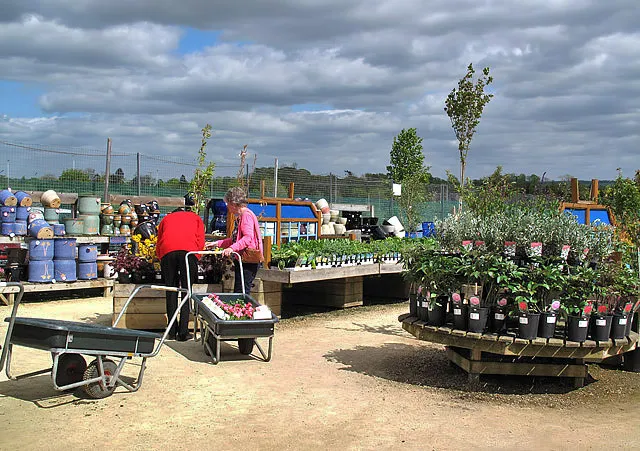
Photo: Walter Baxter , CC BY-SA 2.0, via Wikimedia Commons
The first clue is the trolley. Then the smell of compost gives way to something darker: coffee, butter browning in a pan, maybe a natural wine list chalked on a board. You are still in a garden centre — there are terracotta pots stacked to the ceiling and a display of secateurs — but the room has changed. The café has become a restaurant. The restaurant has become a destination. And the destination is, improbably, just off a roundabout near a retail park.
In 2026, some of Britain’s most interesting kitchens are hiding in garden centres. Not the sad self-service counters of memory, with their laminated menus and lukewarm soup, but proper rooms with chefs who care about produce, plates that look like they were chosen by someone with an eye, and wine lists that mention growers rather than grape varieties. The garden centre has become a hybrid: nursery, deli, design shop, restaurant and social club. The result is one of the strangest and most pleasurable developments in British food culture.
From tearoom to tasting menu
The shift did not happen overnight. Garden centres spent the 2010s widening their offer: farm shops, gift departments, furniture barns, Christmas displays that would humble a department store. The café was part of the package, but rarely the point. Then a few operators realised that the people coming through the doors were not only buying bedding plants. They were buying lunch, and they were prepared to travel for it.
In the past few years, the kitchen has moved to the centre of the business. Chefs with restaurant backgrounds have taken over café spaces and kept the setting but changed the ambition. Menus are shorter. Bread is better. Vegetables are treated as the main event rather than the garnish. Natural wine has arrived, often poured by the glass and often explained with more enthusiasm than a sommelier in a city dining room. The garden centre has discovered that its customers are curious.
That curiosity is the key. Garden centres already attract people who like looking at things: plants, pots, tools, fabrics, oddities. They are browsers by temperament. A restaurant inside a garden centre catches that same mood. You came for a bag of compost and stayed for a plate of grilled leeks with a glass of something cloudy. The pleasure is in the unplanned detour.
Why the hybrid works
The economics are not mysterious. Garden centres have parking, footfall, space and a customer base that skews older, wealthier and more open to a long lunch than the average high-street café. They also have something city restaurants often lack: a sense of occasion without the performance. You do not need to book three weeks ahead or dress for a room. You can arrive muddy, eat well and leave with a houseplant.
For chefs, the appeal is freedom. Rents are often lower than in town, kitchens can be larger, and the audience is already there. The garden centre benefits from the restaurant’s reputation; the restaurant benefits from the garden centre’s customers. It is a symbiosis that would look cynical if the food were not good. In the best examples, it is not cynical at all. It is simply a smarter use of a strange British institution.
The design helps. Garden centres have always been good at staging: the winding path through the shrubs, the tableaux of pots, the seasonal displays. The new restaurant rooms borrow that theatricality. You might eat beside a wall of dried flowers, under a glass roof, or next to a shelf of handmade ceramics that are also for sale. The shopping is not separate from the meal; it is part of the atmosphere. You finish your coffee and buy the plate you ate from.
The curious diner’s new map
What does this tell us about how Britain discovers food in 2026? Mostly that discovery is no longer linear. We used to find restaurants through critics, guides, friends and, more recently, social media. Now we find them in places we did not think of as food destinations: farm shops, museums, bookshops, railway arches, and yes, garden centres. The surprise is part of the appeal. A restaurant in a garden centre is a pearl in an unlikely shell.
This is not a London story, either. Some of the most interesting examples are in the Home Counties, the Midlands, Scotland and the West Country, where a garden centre can be the most design-conscious room for miles. They serve a audience that wants good food without the friction of a city. They also serve younger diners who have grown tired of identikit restaurant groups and are willing to drive for something that feels local and specific.
There is a gentle etiquette to these places. Book if you can. Do not treat the restaurant as a creche while you shop. Ask about the wine, but do not interrogate the server as if they are a sommelier in a Michelin room. And remember that the garden centre is still a garden centre: the person next to you may be buying a wheelbarrow, not a tasting menu.
The best of these hybrid spaces do not pretend to be urban restaurants. They are something else: a third place between retail and leisure, where the plants are for sale and so is lunch. In 2026, that is where some of Britain’s most interesting cooking is happening. You just have to look past the compost.
The pearl in the potting shed
Abalon’s interest is in the find that rewards a second look, and the garden-centre restaurant is exactly that. It is easy to dismiss. It is not in the guidebooks. It does not have a queue around the block. But it offers something increasingly rare: a good meal in a place you did not expect, with a trolley park outside and a shelf of ceramics by the door. The setting is ordinary. The cooking is not. That is the quiet pleasure of the new British garden centre — a place where the pearl is hidden in the potting shed.