Hills Done By Hand: The Weekend Scrubbers Keeping Britain’s White Horses Legible
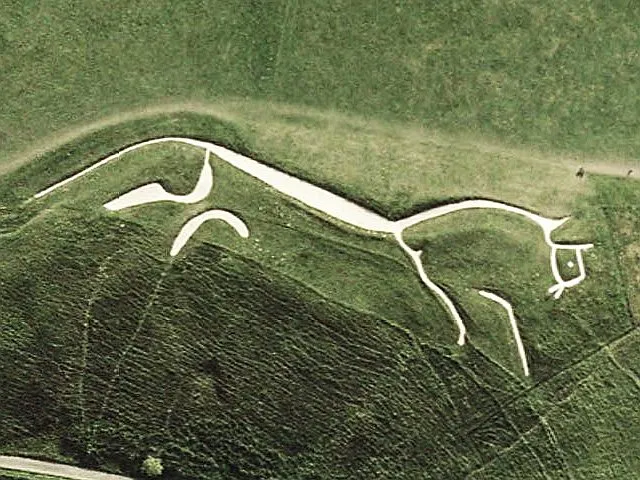
Photo: USGS, Public domain, via Wikimedia Commons
From the Ridgeway, the Uffington White Horse can look less like an animal than a rumour: a pale, stretched shape on the Oxfordshire escarpment, visible only when the light and the season agree. Up close, it is stranger still — not a smooth sculpture but a body of exposed chalk, kept legible by human hands. This is the odd truth of Britain’s hill figures. They are landmarks, yes, but they are also maintenance jobs. And the people who do the maintaining tend not to think of themselves as custodians of ancient art. They think of themselves as people with a weekend, a strimmer and a reasonable pair of boots.
A Horse Made of Weather
The Uffington White Horse is the aristocratic ancestor of the genre: a Bronze Age figure, cared for by the National Trust, protected as a scheduled monument and watched over by a small army of volunteers, archaeologists and estate staff. It is also, in practical terms, a fragile patch of ground. Left alone, chalk grassland closes in. Weeds root. Stones shift. Rain washes the bright surface dull. The figure does not dissolve dramatically; it simply becomes less white, less horse-shaped, less itself.
That is why the annual scrub is such a curious event. It is part housework, part ceremony and part archaeological caution. Volunteers do not simply attack the hill with bleach and enthusiasm. They hand-pull weeds, brush away loose soil, barrow fresh chalk where it is needed and take instruction on where feet may go. The point is not to restore the figure to some imaginary pristine state. It is to keep it visible without loving it to death.
The Tools Are the Point
What strikes you, watching a scrub, is how modest the equipment is. Soft brushes. Buckets. Gloves. Kneeling mats. A wheelbarrow with a squeaky wheel. The job is repetitive and slow, which is precisely why it attracts a certain kind of person. There is satisfaction in seeing a line of chalk reappear under a layer of turf and leaf litter. There is also camaraderie in the shared complaint about the weather.
Lesser-known figures have their own local routines. Westbury White Horse in Wiltshire, the Alton Barnes horse, the Cherhill figure with its landmark obelisk nearby, the Long Man of Wilmington in East Sussex — each has a different relationship with its parish, its landowners and its visitors. Some are cared for by councils, some by trusts, some by informal groups who know the hill better than any management plan. The details vary, but the pattern holds: a figure becomes visible because someone, somewhere, has decided it matters enough to keep clearing it.
Arguments in the Chalk
Maintenance is never neutral. Should a figure be scrubbed by hand or treated with herbicide? Should paths be fenced to protect fragile chalk downland? Should dogs be kept on leads? Should drone photographers be politely discouraged? Should a hill figure be allowed to soften into the landscape, or should it remain a bright, legible mark? These are not idle questions. They are arguments about what a landmark is for.
Some conservationists argue that the archaeology matters more than the silhouette. Scrub too vigorously and you risk disturbing the very ground you are trying to protect. Others point out that a figure nobody can see stops being a public landmark and becomes an obscure archaeological site with a nice view. The compromise tends to be cautious, seasonal and slightly unsatisfying to everyone — which is often the sign of a sensible compromise.
There is also the matter of re-cutting. Popular imagination loves the idea of villagers gathering to carve a horse afresh, but modern re-cutting is rare, regulated and expensive. Most annual work is subtler: weeding, edging, cleaning, monitoring. The romance is in the continuity, not the drama.
What Visibility Costs
A hill figure is a strange kind of public property. You cannot put it in a vitrine. You cannot lock it up at night. It belongs to the view, to the parish, to the walkers who use it as a waypoint and to the volunteers who know exactly which patch of chalk turns muddy first. That makes it vulnerable to the ordinary pressures of affection: erosion, litter, unofficial paths, the occasional well-meaning visitor who decides to stand on the horse’s eye for a photograph.
But it also makes it unusually democratic. You do not need a membership card to look at a white horse from a footpath. You do not need to understand scheduled monument consent to notice that the tail is looking a bit green around the edges. The volunteers who turn up with brushes are not gatekeeping a treasure. They are doing the unglamorous work that keeps a shared thing shared.
A Landmark You Can Join
If you go to see one of these figures this winter, go with the right expectations. You will probably not witness a dramatic restoration. You may see a group of people in waterproofs, bent over a chalk slope, arguing gently about a wheelbarrow. You may see a National Trust ranger explaining why the grass on the left is not to be trampled. You may simply see a hill, a sky and a pale shape that has been kept pale by people you will never meet.
That is the pearl in all this. Britain’s hill figures are often described as ancient wonders, but they are really acts of collective care that happen to be enormous. They survive because each generation decides, again and again, to do the boring bit: the weeding, the brushing, the walking up a hill with a bucket. The horse stays white because someone made it so. And that, in a quiet way, is more impressive than any grand unveiling.