The Cabinet of Small Futures: Inside Britain’s Seed-Lending Libraries
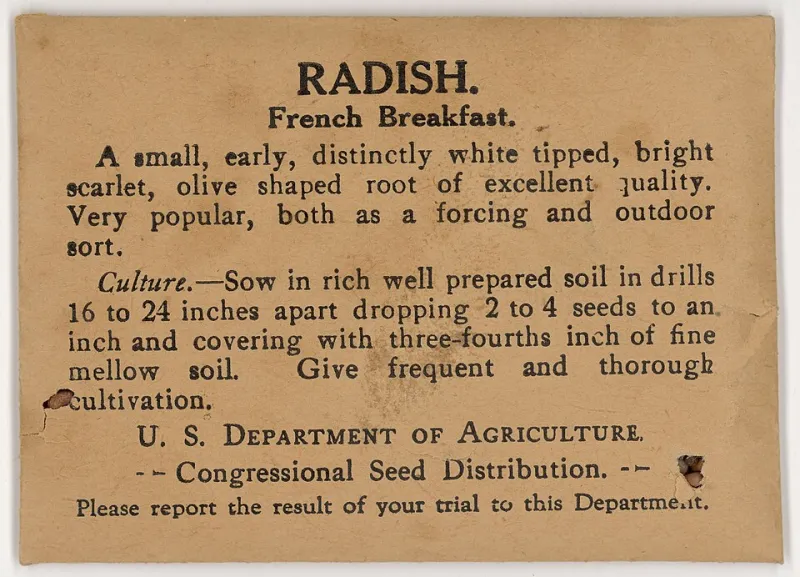
Photo: Unknown authorUnknown author or not provided, Public domain, via Wikimedia Commons
There is a drawer in Britain that behaves like a library and a time capsule at once. It is usually modest: a filing cabinet, a repurposed card catalogue, a wooden box with a handwritten index. Inside are paper packets, each one labelled in biro or fountain pen — ‘Crimson Flowered Broad Bean’, ‘Auntie Elsie’s Tomato’, ‘Meadow Crane’s-Bill, please return’. You take a packet home, sow it, and at the end of the season you try to bring back something of the next generation. The seed library is not a lending library of books. It is a lending library of futures.
Across the UK, these small cabinets have been appearing in public libraries, community centres, allotment sheds and cafés. They are not a single organisation so much as a loose habit: borrow, grow, return. The scale is deliberately human. A seed library might hold fifty varieties or five hundred, but its real collection is the knowledge attached to them — who grew this bean, which summer it survived, why the label says ‘small but mighty’ in someone’s grandmother’s handwriting.
A Library Where the Books Are Alive
The comparison to books is tempting but imperfect. A borrowed novel comes back dog-eared; a borrowed seed comes back transformed. You are not returning the same object. You are returning its descendants, hopefully with a note about how they behaved in your soil. This is what makes seed libraries such an unusual form of local archive. They preserve not just genetic material but social memory: the allotment neighbour who passed on a courgette, the school garden that saved its best marigold, the family whose runner beans travelled from one county to another in an envelope.
In 2026, the appeal is easy to understand. Gardeners are curious about flavour and resilience. Allotment waiting lists remain long. Supermarket seed racks are convenient but anonymous. A seed library offers something more tactile: a packet with a story, a name, a place. It also offers a gentle rebuke to the idea that heritage is something you visit behind glass. Here, heritage is something you sow, eat and share.
The Handwritten Packet
Spend time with a seed librarian and you will hear about labels. Not the printed kind, but the handwritten ones. Volunteers often talk about the moment a packet arrives with a message on it: ‘Grew well against the shed wall.’ ‘Best flavour, poor germination, sorry.’ ‘From Dad’s plot, 1998.’ These annotations are not clutter. They are metadata of a sort, and they tell you what a database rarely can — how a variety actually lives in the world.
The volunteers themselves tend to be practical romantics. They are not usually seed scientists. They are retired teachers, library assistants, allotment secretaries, parents who once ran a school gardening club. They learn as they go: how to dry beans, how to ferment tomato seed, how to test germination on damp kitchen paper. They also learn diplomacy. A seed library depends on trust. If someone borrows a packet and never returns seed, the cabinet does not collapse. But if nobody returns anything, the collection thins. The ethic is soft, persuasive, slightly hopeful.
Return, Ideally
That ‘ideally’ matters. Seed libraries are not seed banks in the cold-storage sense. They are not fortress archives with backup generators. They are living, leaky, social things. Some run on an honour system: take a packet, leave a packet. Others ask borrowers to return seed from at least one plant, or to attend a seed-saving workshop first. Many operate on a simple principle: try. If your courgettes fail, tell the librarian. Failure is information too.
The return can be as modest as a jam jar of dried beans or as elaborate as a labelled envelope with notes on flowering time. What matters is the loop. A seed that goes out and comes back has done something a shop-bought seed cannot: it has adapted, however slightly, to a particular place. Over years, that can add up. A variety that thrives in a damp northern allotment or a sheltered London courtyard is not the same as one grown in a seed company’s trial field. It carries local weather in its history.
Heirlooms Without Glass Cases
Britain has a long tradition of seed saving, from cottage gardens to allotment societies. The modern seed-library movement took root in the 2010s, part of a wider interest in food provenance and community resilience. Organisations such as Garden Organic’s Heritage Seed Library have long kept rare varieties in circulation, while smaller local projects have done the same at street level. The difference with a seed library is public access. You do not need to be a member of a specialist society. You need a library card, or sometimes just a Saturday morning.
This openness raises interesting questions. Who owns an heirloom? Can a family variety be lent, copied, returned? Seed libraries tend to answer with practice rather than doctrine: share widely, document carefully, respect the story. They are not trying to lock varieties away. They are trying to keep them moving. In that sense, they are less like museums and more like the best kind of neighbourhood: generous, slightly untidy, dependent on people showing up.
The Ethics of the Drawer
There is a quiet ethical code inside the cabinet. Don’t take more than you can grow. Don’t return seed from diseased plants. Label clearly. If you cross varieties, say so. Don’t assume every borrower has a garden; some have windowsills, balconies or a single pot. The code is rarely printed in full. It is passed on in conversation, over a table of envelopes, while someone explains how to tell a ripe seed head from an unripe one.
That is part of the charm. Seed libraries are not polished services. They are infrastructure made from patience. A librarian might spend an afternoon filling packets and still wonder whether anyone will borrow the odd-looking kale. Then a child takes it home, grows it in a yoghurt pot, and brings back a pinch of seed the following autumn. The cabinet grows a little more social.
How to Join the Quiet Trade
If you want to find one, start local. Ask at your library, allotment association or community garden. Look for seed-swap days in late winter and early spring. If there is no seed library nearby, the model is easy to imitate: a box, a set of envelopes, a simple label, a few generous gardeners. The rules can fit on an index card. The point is not perfection. The point is circulation.
In a country that loves a formal archive, the seed drawer is a reminder that some inheritances are meant to be handled. They are meant to be sown, eaten, dried, labelled and passed on. The cabinet of small futures does not ask for silence. It asks for a harvest, a handwritten note, and the willingness to bring something back.