The Flake Files: Britain's Hand-Raked Sea Salt Revival
On a grey morning in early November, the Blackwater estuary is doing what it does best: looking unremarkable and quietly beautiful. The tide is out, the mud is the colour of strong tea, and a thin wind carries the smell of weed and wet wood. Somewhere along this Essex coastline, a salt maker is watching the sky rather than the water. Hand-raked sea salt is not a business for people who need certainty. It is a business for people who can read a forecast, wait, and then move fast.
That tension — between slow landscape and sudden harvest — is the story of Britain's small-scale sea salt revival. It is not a new industry. Maldon Salt has been working the Essex marshes since 1882, and the method of boiling brine in shallow pans and drawing off the flakes by hand is older still. But in 2026, something has shifted. The salt shelf in a good deli or farm shop is now a place of provenance, with named makers, harvest dates and flake sizes that matter to cooks. The question is whether all this fuss is justified. Spoiler: often, yes.
The Marsh at First Light
The Essex marshes are the spiritual home of British flaky salt. The geography is simple and stubborn: low-lying land, salty creeks, and a long history of harvesting what the tide leaves behind. Walk out along the sea wall near Maldon and you can see the shallow lagoons and channels that have been managed for salt for generations. The landscape is flat, wide and slightly melancholic in winter, which makes the sudden appearance of a salt pan — a low, dark tank of brine — feel almost theatrical.
Further north and west, the settings change but the logic does not. On the Isle of Skye, sea salt is made in small batches from the clean water of the sea lochs, with the weather doing much of the work. In Ayrshire, Blackthorn Salt uses a Victorian tower and a slow evaporation process that turns brine into crystals over days rather than hours. On Anglesey, Halen Môn has been hand-harvesting since 1999, and its visitor centre has become a quiet pilgrimage for people who like their condiments with a side of coastal walk.
What unites these places is not a single method but a shared temperament. Salt making is agricultural in its rhythms: you are at the mercy of wind, rain, humidity and temperature. A hot, dry spell is a gift. A damp week is a test of patience. The makers I spoke to all used the same word — 'watching' — as if the sea were a neighbour who might drop by unannounced.
A Flake Apart
The difference between hand-raked sea salt and the cheap stuff in a cylinder is mostly texture, and texture is not a small thing. Flaky salt has a fragile, pyramidal structure that crunches briefly and then dissolves. It sits on top of food rather than disappearing into it. That is why chefs finish a steak or a tomato salad with a pinch of flakes rather than a shower of fine grains. You get a burst of salt on the tongue, then it is gone.
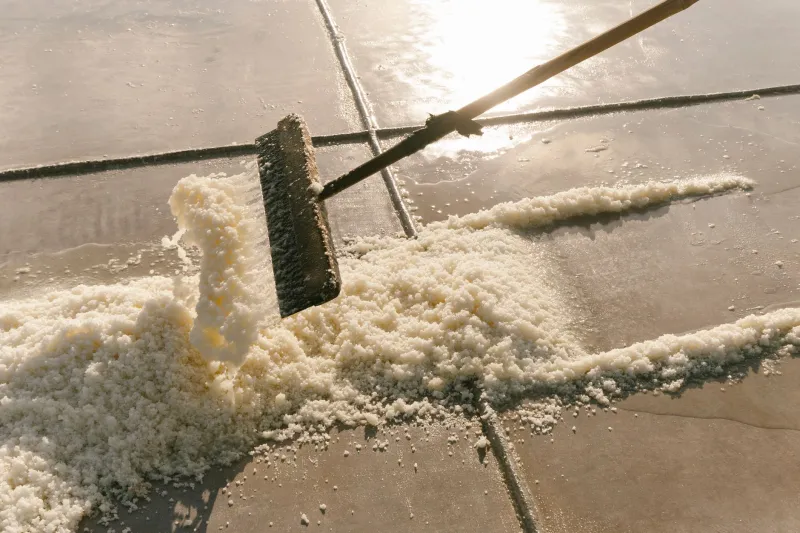
Hand raking is what creates that structure. In a shallow pan, brine is heated gently so that crystals form on the surface. The maker draws a rake through the brine to gather the flakes before they sink or grow too large. It is a skilled, repetitive movement — part farming, part cooking, part dance — and it cannot be rushed. The best flakes are thin, irregular and slightly damp when they are scooped out. They are then dried slowly, so they keep their shape.
This is also why the price is higher. A 250g box of British hand-raked sea salt might cost £6 to £12, depending on the maker and the flake size. That sounds like a lot next to a 99p tub of table salt. But you use it differently: a pinch at the end, not a spoon in the pot. A box lasts months. And you are paying for labour, small batches and the fact that the maker probably spent the morning staring at clouds.
The Practical Guide: Pans, Pails and Purchases
If you want to see the process for yourself, a few British salt makers welcome visitors. Halen Môn on Anglesey has a visitor centre and offers tours where you can see the pans and taste the brine. Blackthorn Salt in Ayrshire runs tours of its tower and evaporation house, which is a good rainy-day option with a serious salt payoff. Isle of Skye Sea Salt has a shop and offers a window into the process, though the weather often has the final say on what you will see.
Maldon Salt does not run public tours, but you can visit the town, walk the sea wall and buy the salt locally — which is its own kind of pilgrimage. The Maldon promenade and the Hythe quay are good starting points, and the town's small shops often stock the famous flake. Wherever you go, check opening times before you travel. Small producers are not theme parks, and many are still recovering from the wet winters of recent years.
Buying direct is the best way to support the makers. Most have online shops, and many sell at farmers' markets in London, Bristol, Edinburgh and beyond. Look for harvest dates on the packet and a clear description of the flake size. Coarse flakes are for finishing; finer grains are better for baking and brining. If you see a bag of 'sea salt' with no maker's name and no location, you are probably buying a blend of imported salt. That is fine for pasta water, less fine for a Sunday roast.
What Makes It Worth the Price
The honest answer is that local sea salt is not magic. The mineral content varies, and the idea of terroir in salt is debated among food scientists. But the texture is real, and the difference in flavour — a cleaner, brighter salinity — is noticeable to most palates. More importantly, buying British hand-raked salt supports a small, fragile industry that depends on clean water and stable coastlines. In 2026, that feels like a reasonable trade.
There is also the pleasure of the thing. A box of flaky salt on the table is an invitation to pay attention. You pinch it, you scatter it, you taste the crunch. It slows you down. And in a food culture that often prizes speed, a little slowness is worth paying for.
So next time you are near a marsh, a sea loch or a windswept estuary, look for the salt. It might be in a shop, a visitor centre or a farm building with a hand-painted sign. Buy a box. Take it home. Finish your eggs with it. That is the whole point.