The Memory Vial: Why Britain’s Tiny Perfumers Are Turning Place into a Collectible
There is a particular kind of British souvenir that does not announce itself. It is not a tea towel, a fridge magnet or a snow globe with a wonky tower inside. It is a small bottle, often unlabelled beyond a handwritten batch number, that smells like a place you once stood in — or a place you wish you had. In 2026, as independent perfumers across the UK turn limited-run fragrances into objects of quiet obsession, scent is becoming the souvenir that a resale-minded generation actually wants to keep.
A Souvenir You Can Wear, Not Shelf
The appeal is easy to understand. A perfume bottle takes up almost no space. It travels well. It can be worn, layered, decanted, swapped or sold on. Unlike a ceramic landmark, it does not require a mantelpiece. And unlike a photograph, it does not simply document a view; it reconstructs the air around it.
That is the promise made by a growing number of small British perfume studios. Some work from converted sheds in Somerset, others from shared benches in Brighton or Edinburgh, others still from stalls that appear on Saturdays and vanish by Sunday evening. Their fragrances are often blended around a specific memory or landscape: rain on a Norfolk beach, the inside of an old library, the green sap of a Yorkshire hedgerow, the warm dust of a London market at closing time.
This is not the same as the heritage perfumery story of big houses and century-old formulas. It is smaller, stranger and more personal. The makers are often self-taught, or trained in adjacent crafts, and they tend to work in batches so small that a single ingredient shortage can wipe out a season. That fragility is part of the attraction. A scent that might not exist next year feels less like a product and more like a find.
The Studio Behind the Stall
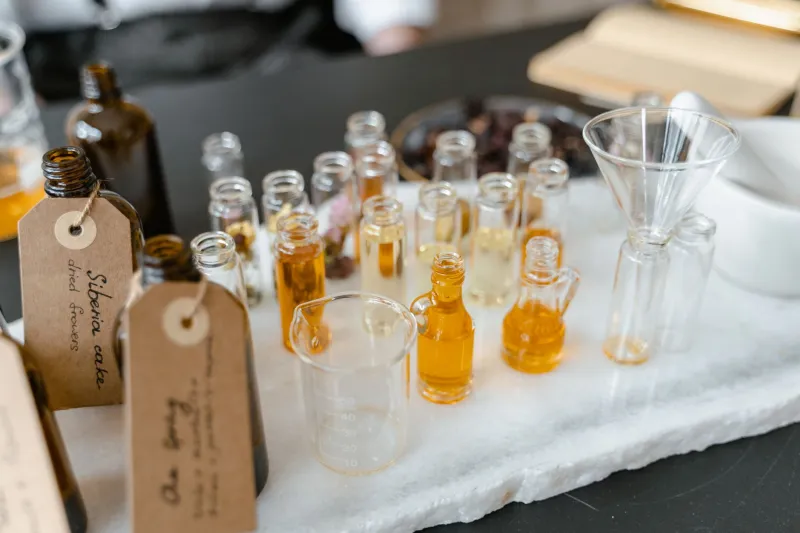
What makes these perfumeries compelling is not just the liquid. It is the retail theatre around it. Many operate through workshops, pop-ups and market stalls, where the maker is often the person handing you the tester. You might smell six things in ten minutes. You might hear about the difficulty of sourcing a particular resin, or why the opening smells sharper on paper than on skin. The transaction is slow, conversational and slightly awkward in the best way.
That personal approach matters because scent is difficult to sell online. A photograph of a bottle tells you almost nothing. A description can gesture at bergamot, vetiver or smoke, but it cannot tell you whether the thing will smell like a memory or a cleaning product on your own wrist. Small perfumers have responded by leaning into the physical encounter: discovery sets, refillable travel sprays, scent salons, and workshops where customers blend a simple accord to take home.
For buyers, this creates a different kind of relationship. You are not just collecting a fragrance; you are collecting the afternoon you spent choosing it. The maker’s handwriting on the label, the batch date, the slightly imperfect fill line — these become part of the object’s story. In a market flooded with identical bottles and algorithmic recommendations, that feels increasingly rare.
Why Small Batches Make Strange Sense
Limited runs also suit the economics of tiny studios. Natural materials are expensive and variable. A small maker cannot always guarantee the same jasmine absolute or the same local beeswax from one year to the next. Rather than hide that inconsistency, many build it into the product. Batch variations become a feature, not a flaw — a way of marking time and place.
This is where scent starts to behave like a collectible. A first edition, a discontinued accord, a bottle from a particular season: these details matter to a certain kind of buyer. The resale-minded generation, already fluent in the language of limited drops and archive pieces, recognises the logic. But the comparison only goes so far. Perfume is a consumable. It evaporates. It turns. It is meant to be worn. That makes it a more intimate collectible than a trainer or a handbag, and a more honest one.
The Resale Question
There is a practical side to all this. Fragrance resale is not new, but it has become more visible. Forums and marketplaces trade in discontinued bottles, partial decants and travel sizes. Small British makers are not necessarily designing for that market, but they are aware of it. Limited availability creates demand. A scent that sold out at a weekend market can reappear online at a premium. A workshop exclusive can become a quiet trophy.
Yet the better small perfumers tend to resist hype. They know that a fragrance is not really a financial instrument. It is a mood, a memory, a daily ritual. The most loyal customers are not necessarily the ones buying to flip. They are the ones who return for a refill, who bring a friend to a workshop, who send a handwritten note because a scent reminded them of a grandmother’s garden. That kind of following is slower to build, but it lasts longer.
A Very Personal Kind of Retail
What these perfumeries are really selling is attention. The maker has paid attention to a place, a feeling or a half-remembered moment, and has tried to bottle it. The customer pays attention in return. In a retail landscape dominated by screens and same-day delivery, that exchange feels almost old-fashioned. It also feels like a relief.
The best of these scents do not smell like a branded version of Britain. They smell like someone’s Britain: specific, partial and slightly off-centre. A coastal perfume that smells of wet stone rather than sunshine. A city scent built around bus exhaust and blossom. A workshop blend that smells like the inside of a favourite bookshop. These are not universals. They are invitations.
That is why scent works as a souvenir. It does not reproduce a place. It edits it. It takes the part you remember — or the part the maker remembers — and makes it portable. For a generation wary of clutter but hungry for meaning, that is an appealing trade. A bottle of perfume is small enough to carry, personal enough to defend and strange enough to feel like a discovery.
At Abalon, we tend to look for the pearl in the ordinary: the small, lustrous thing hidden in plain sight. Britain’s tiny perfumeries are full of them. You just have to follow your nose to the back of the market, up the studio stairs or through the door with the handwritten sign. The souvenir waiting inside is not a place. It is the memory of one, bottled in a batch small enough to matter.